
How Arrest Warrants Work in Essex County
Every criminal arrest warrant in Essex County starts with a complaint and a probable-cause review. Virginia Code §19.2-72 spells out what the paper must contain: the accused's identity, a description of the offense, a direction to an appropriate officer to arrest, and the issuing officer's signature. The magistrate is the usual first stop. In Essex, that means District 15's magistrate office, which handles local issuance and bail. An authorized judge can also issue a warrant. Once issued, the case file lands with GDC, JDR, or Circuit Court, depending on the charge.
Essex County Arrest Warrant Probable Cause
Before signing anything, the issuing officer reads the complaint and may question witnesses under oath. Felony complaints must be written. Statute requires the same for other listed complaint types. If probable cause is there, the judicial officer signs the warrant and names the officer or officers who will execute it. Virginia Code §19.2-72 sets out these required contents for any Essex County warrant.
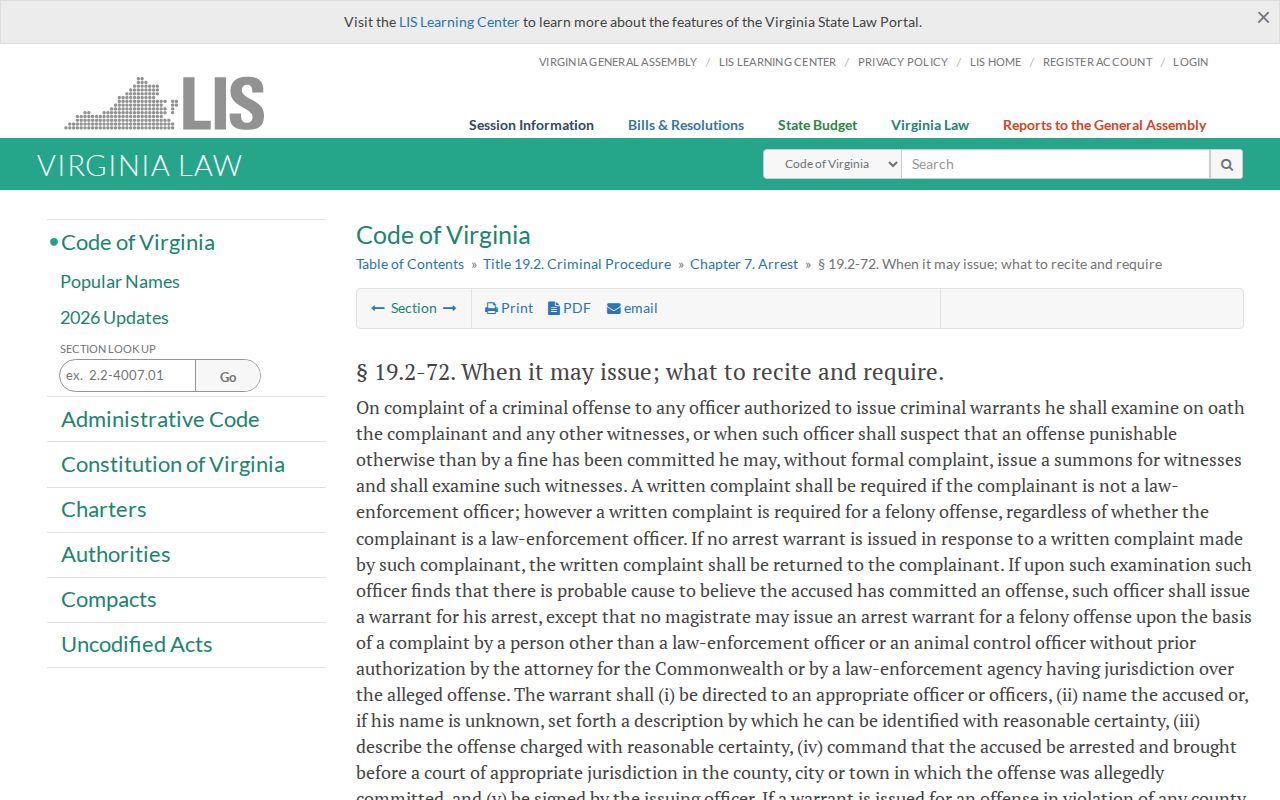
The statute text shows the issuing standard for a warrant. It is not an individual Essex County document.
Essex County Arrest Warrant Details
Virginia law defines the core fields of a warrant. Essex County posts no sample arrest-warrant listing and no local number format. Online court systems may show only selected case details, so ask the clerk what the actual file contains.
| Case number | Copy the number shown in OCIS or the court file; Essex publishes no warrant-number format. |
|---|---|
| Person named | The warrant identifies the accused or gives a description sufficient to identify them. |
| Offense | The charge must be described with reasonable certainty. |
| Issuing officer | Magistrate or another authorized judicial officer; the warrant is signed. |
| Direction | Names an appropriate officer to make the arrest and bring the accused before court. |
| Bond/release | Conditions depend on the case and judicial decision; no Essex schedule was located. |
Essex County Arrest Warrants and Felonies
Felony cases in Essex County often begin in General District Court with a preliminary hearing, then move to Essex Circuit Court after certification or an indictment. Adult misdemeanors and traffic matters usually stay in GDC. JDR handles its own statutory family and juvenile cases. The court level can shift as a case moves forward. For a felony question, contact the Circuit Clerk and your counsel; the Sheriff can separately confirm whether process is held for service, since the two offices keep different parts of the record. The Essex Circuit Court page lists the Circuit Clerk's contact details along with the court's own.
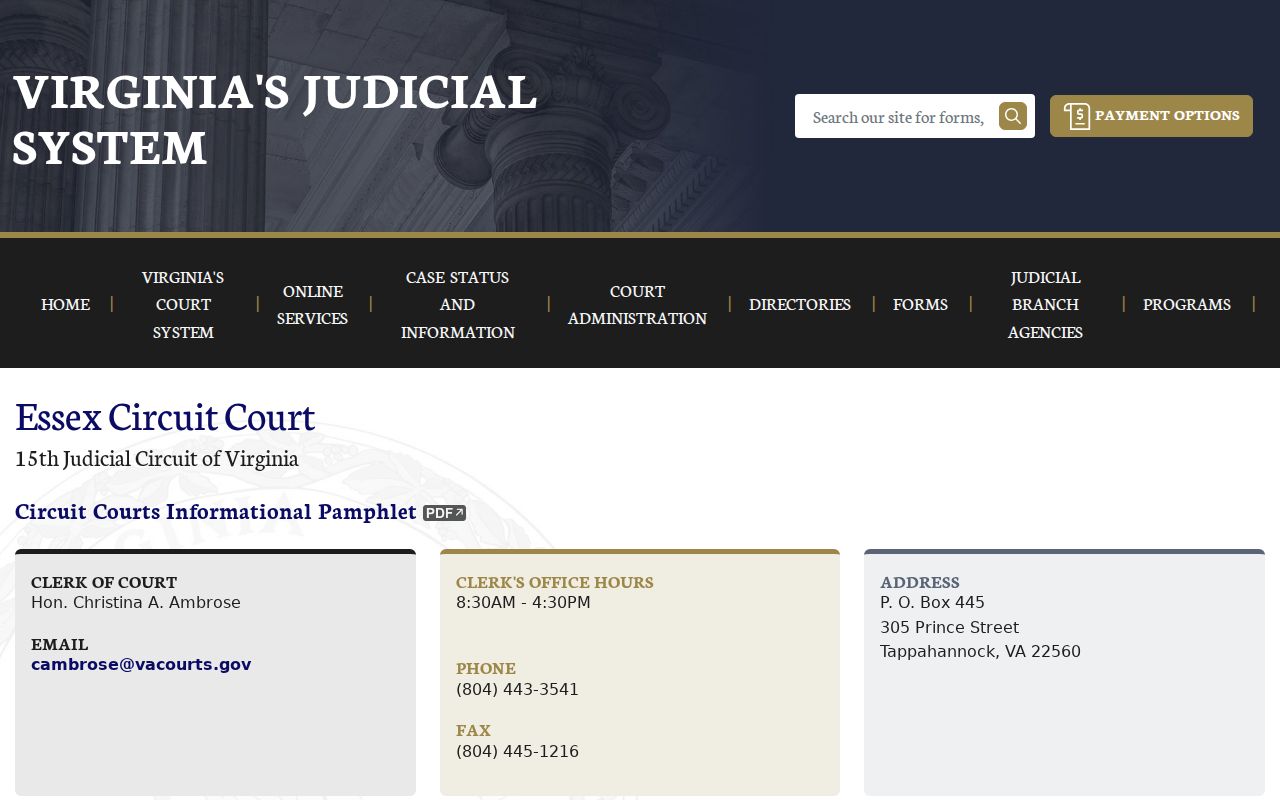
Ask the Circuit Clerk directly. They can confirm whether an Essex County case moved past its General District Court stage.
How Warrants Get Served in Essex County
A warrant directs a law-enforcement officer to act. Depending on the case and the direction on the paper, that may fall to Essex County Sheriff's deputies, Tappahannock Police, Virginia State Police, or another authorized agency. The Sheriff's Office lists Warrants/Civil Process among its functions, but it posts no public roster and no local service schedule. After an arrest, the person goes before a judicial officer without unnecessary delay, and a magistrate or court takes up bail or commitment. Essex County publishes no regional jail roster, no booking site, no surrender window, and no same-day release rule. Call the Sheriff and the issuing clerk before you travel anywhere.
Essex County Warrant Service Agencies
The Sheriff's Office at 304 Prince Street is the county's contact for process and service. For a town-side routing or citation-origin question, Tappahannock Police sit at 104 Commerce Road. A police officer may have applied for or served the warrant, but the issuing court still controls the case date, payment, and recall. The town's police page lists a non-emergency number and ordinary office hours, though no warrant lookup. Bring police questions to the department and court-status questions to the clerk. Tappahannock Police contact details appear on the town's official site.
Essex County Arrest Warrant or Summons
These terms mean different things. A summons orders a person to appear. An arrest warrant commands an arrest based on probable cause, while a bench or FTA warrant follows a missed court obligation. Ignoring a summons can bring later process after the court acts. In Essex County, read the actual court paper instead of guessing from its label.
| Feature | Arrest Warrant | Summons | Bench Warrant |
|---|---|---|---|
| What it orders | Arrest and production before court | Appear at a stated time | Arrest after a court obligation |
| Basis | Probable cause of an offense | Court process requiring attendance | Missed date or other court action |
| Issuer | Magistrate or authorized judicial officer | Court or authorized officer | Issuing court |
| First response | Confirm with clerk and counsel | Attend as directed | Ask clerk about appearance or recall |
Essex County Arrest Warrant Search Limits
A case search has real limits. It can miss very recent process, sealed material, JDR matters, and protected investigations. It can also show a case with no active warrant flag attached. OCIS and GDC are case tools, not proof that no Essex County warrant exists. For covered adult cases, start with OCIS, then call the issuing clerk and the Sheriff. Bring in counsel for anything sealed or pending.
Essex County Federal Warrant Route
Federal warrants follow a different route. The Eastern District's Richmond Division covers Essex County. Those warrants run through federal court process and the U.S. Marshals Service, not the Essex County Sheriff's ordinary case system. A local phone call cannot confirm a sealed federal warrant. Federal docket access may show case events, but it is not a public warrant roster. Counsel or the federal clerk and Marshals route stands apart from state or county process. The EDVA jurisdiction page lists Essex County in the Richmond Division.
Your Essex County Arrest Warrant
Your paperwork is the starting point. The name and case number on it point you to the right court, so call that clerk first. Ask if the active warrant still stands, whether a bond was set, and whether the judge expects an appearance or a motion. Essex County Sheriff Warrants/Civil Process handles service, so ask them how that works. A lawyer can shape the next step, from a voluntary appearance to posting bond to a request to recall or quash the warrant. The county publishes no attorney walk-through policy or set surrender sequence. Before you go anywhere, confirm the address, hours, identification rules, payment instructions, and booking questions. Ask the clerk how the court and Sheriff records will update once the judge acts.
Important: Get case-specific guidance from counsel and the issuing court before you appear; Essex has no published surrender or bond-window procedure.